
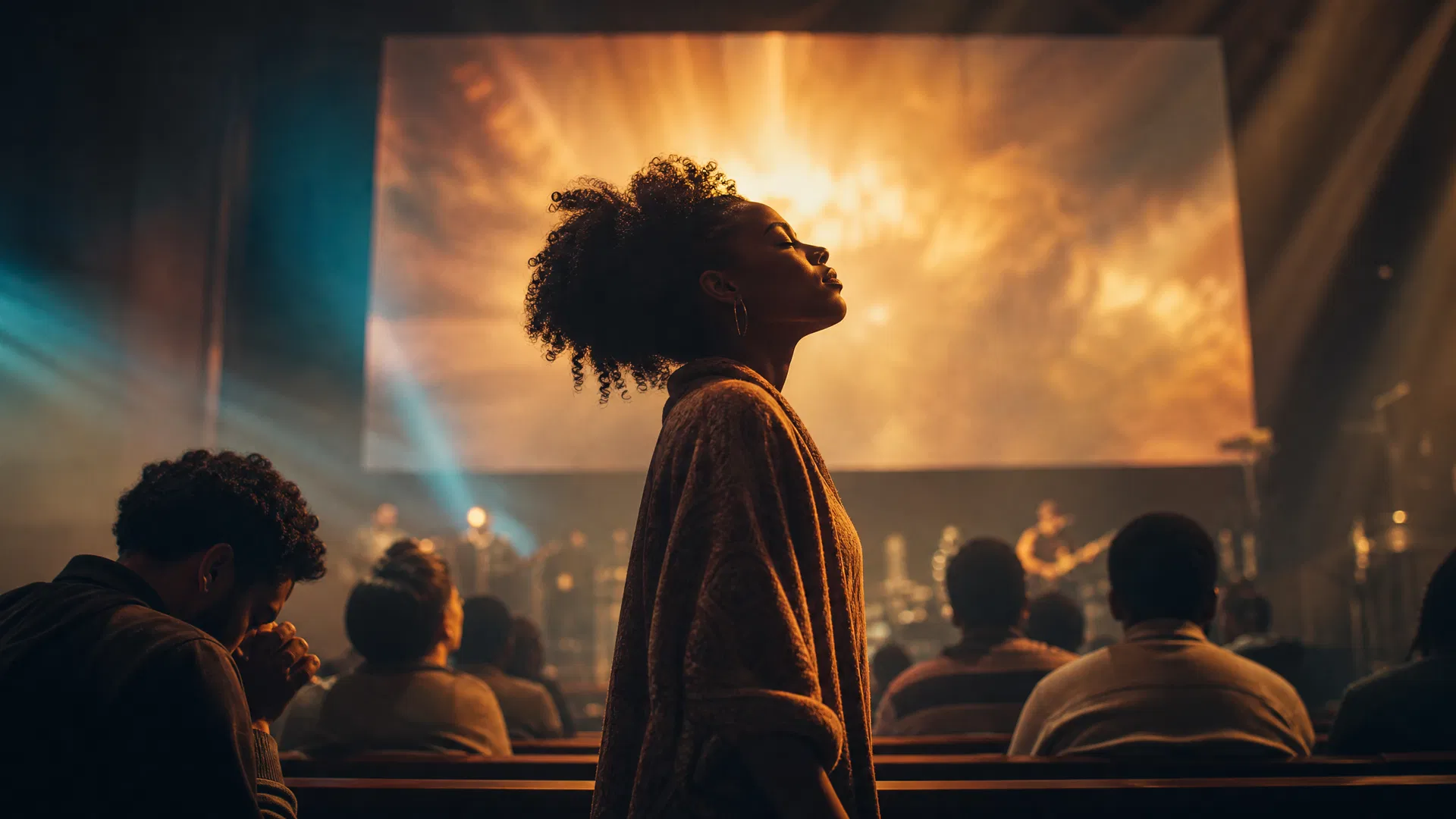
The Ministry of Attention: Creative Worship Videos for a Distracted Church
Creative worship videos are more than production value — they are a ministry of attention. This pastoral case for media in worship shows how films like Silence Versus Stillness and Human Beings, Not Human Doings help a distracted congregation attend to God, and how to place them well in your service.
Every worship leader knows the moment. The room is full, the band is ready, the Scripture is chosen — and yet the congregation is somewhere else. Attention was spent on the commute, the notifications, the unfinished argument, the news cycle. Long before anyone opens a Bible, people carry a scattered mind into a sacred hour. This is the quiet crisis of modern worship — and it is the strongest argument for creative worship videos: not as decoration, not as filler, but as a pastoral tool that helps a distracted people practice attention, the first act of worship.
The case for media in worship is often made in terms of production value or cultural relevance. The deeper case is spiritual. Attention is the doorway through which a congregation enters the presence of God, and it is precisely what our age has trained out of us. A people who cannot be still cannot hear; a people who cannot hear cannot obey.
The Attention Crisis Is Already in Your Sanctuary
Consider how the average person moves through a day: dozens of tabs, hundreds of glances, a steady stream of partial attention — never fully anywhere because always monitoring everywhere. That habit does not disappear when someone walks into church. It follows them into the pew.
This is why a worship service can feel like a competition rather than a sanctuary. For six days, the culture has trained your congregation to skim. On the seventh, worship asks them to stay: the sermon asks for sustained thought, prayer asks for stillness, Scripture asks for slow listening. These are countercultural disciplines in an age of endless interruption, and they require a runway.
That runway is where creative worship videos do their quiet work. A well-chosen film does not add another demand to a crowded mind. It gathers the scattered pieces of attention and returns them, gently, to one thing — the difference between a congregation that merely attends and one that actually arrives.
What Creative Worship Videos Do That Words Alone Cannot
Pastors preach truth with words, and words remain the primary vehicle of God's revelation. But the heart does not receive truth through words alone. It receives through images, sound, memory, and emotion — the whole person. This is why Scripture itself is so visual: shepherds and vineyards, walls and wells, breath and bread. Visual storytelling does not replace the Word; it prepares the imagination to receive it.
They give the inner life a picture
Watch Silence Versus Stillness, and you will see a film that names something most people cannot articulate. The phone is down. The lights are off. The house is quiet. And the mind keeps moving — through unfinished conversations, financial worries, tomorrow's responsibilities, yesterday's regrets. The film draws a distinction many believers need: silence is the absence of noise, but stillness is the presence of trust. One can be achieved by turning off a device; the other has to be received. Play it before a message on prayer or anxiety, and the room is already asking the right question: What is still moving in me?
They slow the room down
Different films serve different purposes. Human Beings, Not Human Doings is a black-and-white spoken-word piece set against a soulful jazz undertone that confronts the pace of modern life with one searching question: what keeps us so busy that we can no longer hear God? Fasting To Fight makes a similar turn, insisting that some battles are not won by doing more — they are won by becoming still enough to hear God. Both films slow a room down. And a slowed room is a room where the Holy Spirit is not competing with the pace of the week.
Why This Is the Case for Media in Worship, Not Against It
Some pastors hesitate to bring film into the service, worried that worship is becoming more like the culture it hopes to reach. The concern deserves a serious answer. The question is no longer whether screens will be present in the worship life of your people. The question is who will disciple the screen.
Every member of your congregation already spends hours each week looking at a glowing rectangle optimized to capture and hold their attention. Those screens train people to consume, to scroll, to skim, to react. A creative worship film interrupts that training, using the same medium to do the opposite work: to slow down, to look deeply, to sit with a truth long enough for it to land. Rightly used, media in worship is not a concession to the culture — it is a counter-formation.
When the screen stops demanding and starts pointing, it stops being a rival to worship and becomes a servant of it.
This is also why the quality of the storytelling matters. A careless film teaches the room that spiritual things can be handled carelessly. A film that is beautiful, honest, and theologically grounded teaches something else: that the message of Jesus deserves the best craft God's people can offer. Churches do not need more content; they need content worthy of the One being worshipped.
How to Choose Creative Worship Videos for Your Service
If attention is the goal, selection is the discipline. Not every film fits every service, and a good worship media idea can still be a poor placement. Two practices protect both the film and the moment.
Match the film to the movement of the service
Every service has movements: gathering, adoration, confession, proclamation, response, sending. A film should serve one movement, not fight for all of them. A reflective piece such as Did God Stop Talking? — which explores the internal chatter that drowns out the voice of God — may belong near a call to prayer. A film like The Rhythm of Jesus, built around breathing and the pattern of withdrawal and return, may serve a sermon on rest or sabbath. Choose the movement first, then the film.
Keep the screen a window, not a wall
Media serves worship best when it points past itself. Introduce films briefly and pastorally. Let them end in a moment of quiet rather than an immediate transition, and follow them with Scripture, not more content. When a film is treated as a window — something you look through toward God — the congregation instinctively treats it the same way. When it is treated as a wall, attention scatters.
A Ministry of Attention
The films in the Mustard Seed Media catalog were not made to fill time in a service. They were made to help the church recover something the modern world is steadily losing: the capacity to attend. A piece like Silence Versus Stillness can be played in a midweek gathering of twenty people or a Sunday service of five thousand and still do the same work — gathering scattered attention and returning it, quieted, to God.
This is the case for creative worship videos, stated plainly: your congregation is already looking at screens. Give them something worth seeing — films that teach their eyes, and through their eyes their hearts, to rest on the One who is always speaking. Attention is the first act of worship, and the right film, placed in the right moment, may be the reason someone finally hears.
Share this post
Get New Posts in Your Inbox
Practical ministry resources delivered monthly. No spam.
Explore our ministry media resources
Worship videos, kids curriculum, and animated films for your church.