
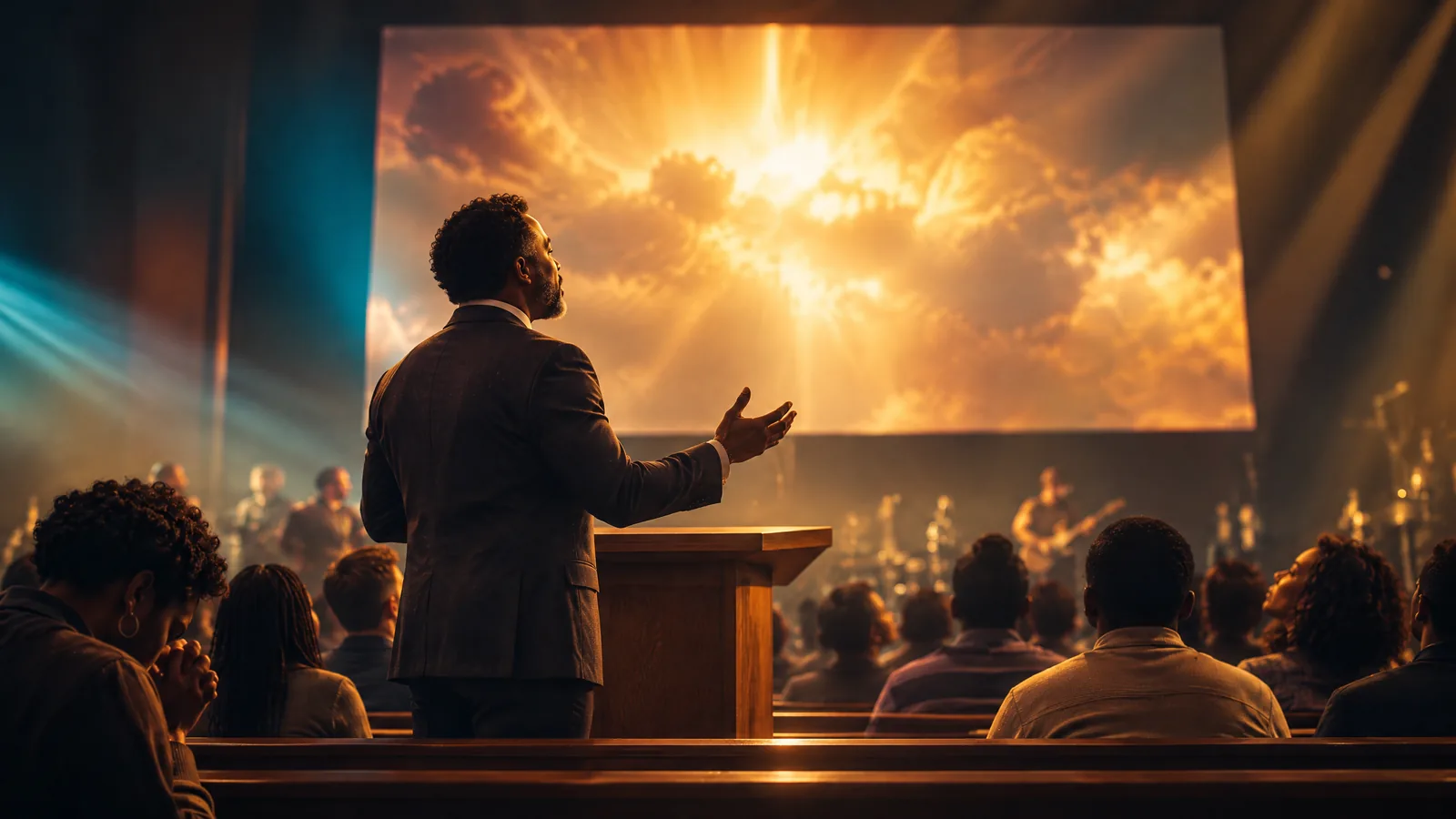
The Case for Visual Storytelling in Church: Why the Screen Can Serve the Sermon
Media in worship is not decoration; it is formation. This practical case for visual storytelling in church shows pastors and creative staff how films like Monopoly, The Mark, and The Family prepare the imagination the sermon needs, and how to place them so the screen serves the Word.
Every pastor is already a storyteller. That is not a modern concession; it is the oldest method of discipleship there is. What has changed is the room. Your congregation now walks into worship having spent an entire week inside moving images—short films, reels, documentaries, and clips that taught them how to feel long before they learned how to think. This is why the case for visual storytelling in church is no longer a question of style. It is a question of formation. The people in your seats have been shaped by pictures all week long, and the question every pastor and creative director must answer is whether the church will merely borrow the culture's images, or redeem them.
What Scripture Has Always Known About Pictures
Visual storytelling is not an innovation imported from Hollywood; it is the native language of Scripture. God rarely settled for explanation alone. He gave Israel stones to stack at the Jordan, feasts to keep through the year, and a lampstand burning in a windowless room—memories made physical so that a generation that never saw the miracle could still feel it. Prophets acted out their messages. Jesus multiplied loaves in front of thousands and then explained what the bread meant.
Jesus Taught in Pictures
When Jesus wanted to describe the kingdom, He did not hand His disciples a definition. He handed them a farmer, a vineyard, a lost coin, a shepherd carrying a wounded sheep home on his shoulders. He spoke of a widow and a judge, a banquet and a gate, a father running down a road to embrace a son who had wasted everything. Every one of those is a frame. Every one of those is a shot. Jesus understood that truth which arrives as an image takes up residence in the imagination, where it can be revisited for the rest of a person's life.
Why Instruction Alone Rarely Changes Anyone
Ask a congregation a month after a sermon on grace to repeat the three points, and most will struggle. Ask them to describe the image that stayed with them, and they will tell you what they saw. That is not a failure of preaching; it is how human beings are made. We become what we keep looking at.
What Visual Storytelling Does That Words Alone Cannot
This is the heart of the case for media in worship. A well-made film does not compete with the sermon; it prepares the imagination the sermon will need. Three things happen in a room when a film is placed well.
It Makes the Invisible Visible
Some truths are easy to preach and almost impossible to feel. Monopoly takes one of those truths—the difference between equal rules and equal starting conditions—and makes it visible in ninety seconds. A board game becomes a mirror. By the time the pastor stands to preach about justice, generosity, or the parable of the laborers, the room has already seen the thing being described.
It Reaches the Whole Room at Once
A film speaks to the eight-year-old in the third row, the teenager who came only because a parent insisted, the first-time guest who has never opened a Bible, and the sixty-year veteran of the faith—at the same moment, in the same language. Few tools in ministry carry that kind of range.
It Gives the Church a Shared Vocabulary
Youth pastor, small group leader, and Sunday school teacher can all reference the same film for months afterward. The Mark, a visually immersive retelling of Exodus, gives a congregation a way to talk about deliverance that does not begin with a lecture. When the whole church has seen the same story, discipleship conversation starts halfway home.
How to Use Video in Worship Services Without Becoming a Spectacle
The fear many pastors carry is legitimate: that film in the sanctuary turns worship into entertainment. The answer to that fear is not to remove the screen but to place the story with intention. Four disciplines keep media serving the Word rather than replacing it.
- Give it a destination. Every film should move the room toward a specific next step—a passage, a prayer, an offering, a response. Never play a video that has nowhere to go.
- Cut the announcements that follow it. Nothing collapses a holy moment faster than a calendar update. Let the film breathe into worship, not into logistics.
- Frame it with a sentence. Two lines from the pastor—why we are watching this and what to look for—turn a clip into a teaching moment.
- Debrief it later. Circle back in the sermon, in small groups, or in the weekly email. A film that is never mentioned again was decoration; a film that is referenced again became curriculum.
A Word to Creative Staff: You Are Not Decorating a Service
If you serve in media ministry, hear this clearly. Your work is not the garnish on someone else's sermon; it is a ministry of formation. Consider the range available to you. The Journey follows three seekers in a modern city, drawn by a star they cannot explain—a doorway into the Magi narrative for anyone who has felt a hunger they cannot name. The Family sets the lineage of Christ inside a contemporary family gathering, with gospel music carrying the story. Believe walks through the Gospel of John with John, Mary Magdalene, and Peter. Whose House Is This? uses spoken word to confront ownership and stewardship. Every Person Has A Story makes the person in the back row impossible to write off. And In My Black Skin wrestles honestly with faith, history, and identity.
That is a curriculum, not a catalog. Curating those pieces is doing theology with images.
Start Smaller Than You Think
You do not need a new building or a five-person video team to begin. Start with one film, placed in one service, framed by one sentence. Watch what happens in the room, then add a second. Churches that build this habit discover that their people begin arriving early, expecting to be met.
Why the Screen Can Serve the Sermon
The debate over media in worship has usually been framed as a contest: Word or image, preaching or film. That framing was always false. The Word is supreme, and the image is its servant—the way a picture in a child's Bible is a servant of the text. What matters is whether the church is intentional about what fills the frame. Left to itself, the culture will happily disciple your congregation through a screen. The church can do the same work in the other direction.
Pastors, preach the Word. Worship leaders, guard the moment. Creative staff, choose the frame with care. When a film is set in the right place, at the right moment, with prayer behind it, it stops being a rival to the sermon and becomes one of its most faithful servants.
The image was never meant to replace the Word. It was meant to make the Word unforgettable.
Explore the full Mustard Seed Media library of creative worship films, giving videos, and animated gospel musicals at mustardseedmedia.org—content made for the church, not merely sold to it.
Share this post
Get New Posts in Your Inbox
Practical ministry resources delivered monthly. No spam.
Explore our ministry media resources
Worship videos, kids curriculum, and animated films for your church.